Before the Hobby Room: Leisure at Home in the Parlour Era
Leisure at home in the parlour era often shared space with household routines. See how visits, reading, and recreation shaped a room’s changing uses.
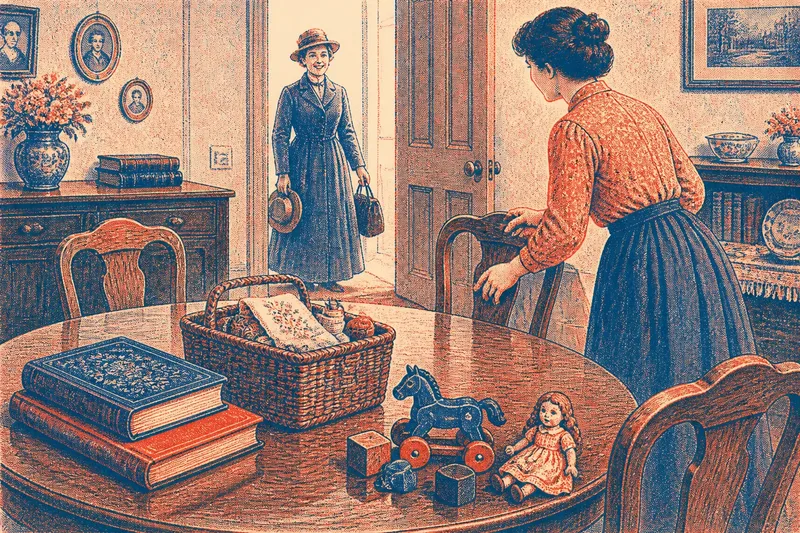
A visitor arrives while a book, sewing basket, and children’s playthings occupy the parlour table. Someone clears a space and draws up another chair. Leisure at home in the parlour era could mean making a shared room work for whoever had gathered and whatever they wanted to do.
There was no single parlour arrangement to represent every home or period. The room’s uses depended on a household’s space, routines, and social expectations. Rather than treating the parlour as a universal historical model, it is more useful to see it as one kind of flexible domestic room—sometimes set apart for visitors, sometimes used for family activities, and not available to everyone.
Why did some parlours serve several purposes?
In homes that had a parlour, it might be used to receive visitors, spend time with family, read, play music, sew, or pursue other quiet amusements. The name did not describe one fixed floor plan or set of rules. Some households had no separate parlour at all.
A room used for several activities could make practical use of limited space. A table might hold a book or needlework, then be cleared for company. Chairs could be moved toward one another for conversation. A shelf or cabinet might keep useful objects close while allowing the room to be tidied when needed.
That flexibility had limits. A visitor, household task, or another family member’s plans could interrupt someone’s leisure. Keeping a room ready for company also meant moving or putting away belongings; a shared room was not necessarily set up for one person’s pastime at all times.
What made a shared room difficult to use?
A room with several purposes can be frustrating when people do not know where things belong or when one activity takes over. The problem is often a mismatch between how the room is expected to look and what its users need to do.
Why might a room feel ready for guests but not for daily use?
When useful objects are hidden away and every chair is positioned for appearance, starting an ordinary activity takes extra effort. Keep frequently used items in a tray, basket, or drawer that can be put away when the room needs to change.
Why might shared activities get interrupted?
Several people may need the same table for meals, paperwork, games, or reading. Agree on a simple signal that an activity is in progress and a clear place to move it if someone else needs the surface.
Why might visitors make a room less comfortable?
A setup designed for solitary use may not invite conversation. Leave some seats easy to turn toward one another and clear a shared surface, while keeping private belongings out of the way.
Why can tidying seem to erase an activity?
If every object must be packed away separately, returning to a pastime becomes another chore. A portable container lets related materials move together and wait until the person can resume.
How did visits shape the parlour?
In households that used a parlour to receive visitors, the room offered a place for conversation within the home. It was not a separate social venue: family members still had to fit visits around ordinary domestic responsibilities.
Movable seating and a shared table could make the room easier to adapt. Chairs could be turned toward one another for a gathering, and the table could be cleared when conversation was the point.
Say a household usually reads and sews in its parlour and expects a neighbor to visit. The starting point is a table occupied by books and a sewing basket, with chairs facing different directions. The household moves the books and basket together to a side cabinet, then turns the chairs toward one another. The expected result is an open shared surface and a seating arrangement suited to conversation, while the reading and sewing materials remain together for later.
Where did reading and recreation fit?
Reading did not require a room to function as a formal library. Someone might read in a shared chair, consult a book at the table, or set it aside when another person needed the space. Access to printed material, light, and a quiet moment mattered, but other uses of the room could shape how long those conditions lasted.
Recreation could include music, conversation, handwork, or other amusements suited to a household and its circumstances. Activities might overlap: a person could sew while listening to conversation, or pause reading when visitors arrived. The parlour is best understood as a setting for changing attention, not necessarily a room dedicated to one pastime.
A modern hobby room often signals a dedicated purpose and keeps related tools in one place. The parlour’s more provisional arrangement allowed activities and furniture to shift as people came and went. Neither approach is inherently better; each reflects the space available and how people share it.
How can parlour flexibility inform a home today?
You do not need period furnishings or a formal room to use the idea of a flexible shared space. Notice which activities compete for the same surface, seats, or storage, then make transitions easier.
- List the room’s shared uses. Observe which activities actually happen there, such as reading, drawing, or hosting visitors. If an activity is rare, give its storage to a more frequent use; if it happens often, keep its materials easier to reach.
- Choose a movable container. Check whether a basket, lidded box, or shallow tray can hold the materials for one current activity. If it fits on a shelf or under a table and is easy to carry, use it; if not, choose a smaller container or a different storage spot.
- Check the shared surface. Observe whether books, supplies, or personal items block the table. If they do, move them together to an agreed spot; if the table is already clear enough for the next activity, leave the arrangement as it is.
- Check the seating layout. Notice whether chairs can turn toward one another without blocking a walkway. If they can, arrange them for conversation; if they cannot, move only the chairs that can be repositioned safely and leave the route clear.
- Choose a place for unfinished activities. Check whether a book or handwork can wait without blocking another person’s use. If it can, use that spot; if it cannot, move the activity into a portable container or agree on another place.
- Review after a routine changes. Observe whether new work, study, or visiting patterns create a conflict over the room. If they do, change the storage or seating arrangement that causes the conflict; if the room still works for its users, keep the setup.
Imagine a household with a small table used for reading and drawing, plus a basket that holds colored pencils and paper. A family member needs the table for paperwork. The household puts the drawing materials together in the basket and places the books on a nearby shelf; the table is then available for paperwork, and both leisure activities remain easy to resume. If the basket proves too full to carry, the household can move only the supplies needed for the current drawing instead.
Think of a shared room like a serving tray: it can carry one arrangement now and another later, as long as its contents can move together. The practical point is not to keep a room ready for every possible use, but to make the next change manageable.
What questions help explain leisure at home in the parlour era?
Did every home have a parlour?
No. Housing and household circumstances varied, and many people did not have a separate room set aside for receiving visitors. The parlour describes one kind of domestic arrangement, not a universal feature of household life.
Was the parlour only for formal guests?
No. In households that had one, a parlour could also be used for family activities and quiet recreation. How formal it felt depended on the household’s habits, furnishings, and expectations.
Did a parlour work like a modern hobby room?
Not necessarily. A parlour could serve several household and social purposes, with furniture and belongings rearranged as needed, rather than being devoted to one activity or person.
Why might a household prefer a dedicated leisure room?
A dedicated room can keep materials in place, while a shared room can adapt to more uses. The choice depends on available space and daily routines, rather than one arrangement being right for every household.
What can the parlour’s changing uses tell us?
The story is not simply that homes moved from shared rooms to specialized ones. Many households still use a living room, kitchen table, or spare corner for several kinds of leisure. The useful question is whether the arrangement helps people begin, pause, and return to activities without making the room difficult for others to use.
For leisure at home in the parlour era, notice the transitions: where a visitor sits, where a book waits, and how an unfinished activity makes room for the next one. A visible, agreed-upon place for shared belongings can preserve flexibility while respecting everyone who uses the room.