Board Games or Cooperative Puzzles for a Mixed-Age Afternoon?
Board games or cooperative puzzles for a mixed-age afternoon? Compare pace, shared attention, and late-arrival options to choose a format that fits.
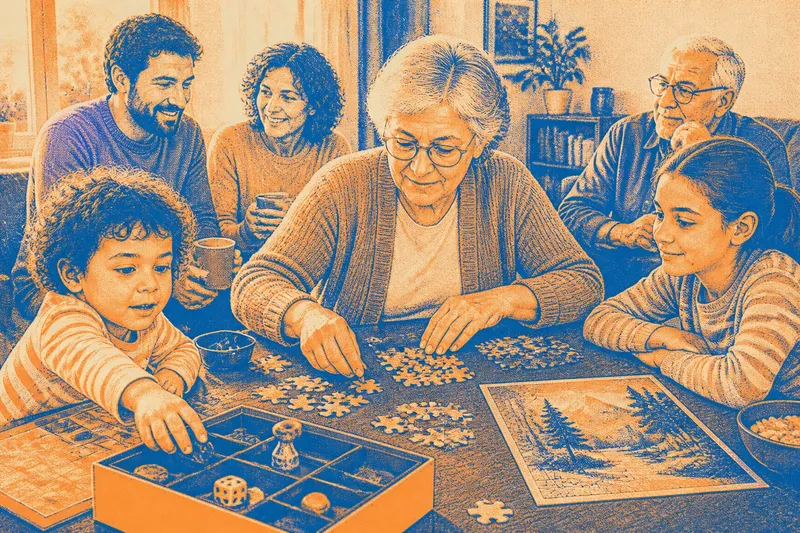
A child reaches for the bright game box while an older relative starts sorting the puzzle pieces by color. For a mixed-age afternoon, board games or cooperative puzzles can both bring people to the same table, but they organize the gathering differently. Choose by the kind of participation your group can sustain, not by which activity looks more impressive.
1. What kind of pace suits the group?
Turn-taking board games create a rhythm: one person acts, the others watch, and the turn passes along. This works well when players enjoy anticipation and can wait comfortably. A short, lively game can give everyone a clear moment to contribute, while a game with long turns may leave younger players or restless adults drifting away.
Cooperative puzzles usually move at a less predictable pace. Several people can search for pieces at once, then pause to compare shapes or assemble a section together. There is no fixed turn order, so a player who needs time to think can keep working without holding up the table.
Consider how your guests handle waiting. If people like a steady sequence and enjoy watching one another make choices, a board game may provide satisfying structure. If they prefer to talk, wander briefly, or work with their hands while others continue, a puzzle is often more forgiving.
2. How much shared attention do you want?
A board game focuses attention on a common set of rules and decisions. Players need to hear instructions, notice what has changed, and keep track of whose turn comes next. That shared focus can make the activity feel lively, especially when the rules are simple enough for everyone to follow.
A puzzle gives people a shared object without requiring them to watch every move. One person can look for edge pieces while another sorts by color, and someone else can chat while fitting a few pieces. The group still has a common aim, but attention can ebb and return without disrupting the whole activity.
Think about the room as well as the table. If conversation, snacks, or movement will compete for attention, a puzzle may tolerate the interruptions better. If the group wants to settle into a single activity together, choose a game with a clear, easy-to-explain turn structure.
3. Which format makes joining late easier?
Late arrivals are simpler to accommodate when there is no private hand of cards, hidden role, or complicated history to explain. A puzzle lets a newcomer start with a visible task: find corner pieces, sort a color group, or help complete a section. The host can explain the shared goal in a sentence and keep the conversation moving.
Board games vary. Some allow a new player to take the next turn with a brief explanation; others depend on earlier choices, individual resources, or a fixed player count. Before choosing, check whether someone can join midway without restarting or giving them a disadvantage that is difficult to explain.
Say you expect a cousin to arrive after the meal while the rest of the family is already gathered. If you choose a cooperative puzzle, leave an unsorted area and invite the cousin to work on it when they arrive; the visible progress should make the task easy to understand. If you prefer a board game, select one whose turns are short and whose current state is easy to summarize, so the newcomer can enter at the next natural pause.
4. How do you choose for different ages and experience?
Age alone does not tell you what someone will enjoy. Look instead at the specific demands: reading, color distinction, fine hand movements, memory, strategic planning, and tolerance for waiting. A game can be welcoming if players can make meaningful choices without needing to read dense instructions. A puzzle can be inviting if its pieces are easy to handle and the image gives people several ways to contribute.
For board games, scan the rules for a long setup, elimination, or a player who must understand several systems before taking a useful turn. If the box includes a short introductory mode, that may help a mixed group start together. For puzzles, consider whether the picture has clearly different areas or relies heavily on subtle shades that may be hard for some guests to distinguish.
Where a rule, component, or age recommendation matters, follow the game's or puzzle's own instructions and adapt the choice to your guests.
5. What should you prepare before guests arrive?
A little preparation prevents the host from becoming the only person who knows what is happening. For either format, choose a comfortable place with enough light and a surface that can remain in use. Keep drinks away from the play area, and make sure guests can sit, stand, or step away without squeezing past one another.
- Check the group size: Match the activity to the people likely to play, and decide whether someone can watch or join later.
- Check the explanation: Read the rules in advance and identify the simplest way to describe the goal.
- Check the attention demand: Decide whether the group is ready for turn-by-turn focus or would prefer flexible, parallel activity.
- Check the table: Make room for components, a puzzle image reference, and comfortable reach from each seat.
- Check the stopping point: Pick a natural pause for a game, or a safe way to set aside an unfinished puzzle without losing its pieces.
- Check the social mix: Choose an activity that gives quieter guests a way to participate without requiring them to compete for attention.
Think of the activity like a serving dish: the best choice is not the largest one, but the one that lets everyone reach in comfortably. That can mean leaving the puzzle partly unsorted or choosing a game with fewer rules rather than trying to use every component.
6. Which format fits your afternoon best?
Use these questions to settle the choice before setting out the activity.
Can a player leave and return without disrupting the activity?
A puzzle usually makes this straightforward because the group can keep working without assigning a formal turn. A game can also work if its turns are brief and the rules make a pause easy to explain.
Do guests enjoy taking turns?
Choose a board game if people like waiting, watching decisions unfold, and having a clear individual contribution. If waiting tends to make the group restless, a puzzle gives several people something to do at once.
Will people want to talk while they play?
A puzzle often leaves more room for side conversation because no one has to follow every action. A board game suits a group willing to give the table its attention, particularly when the rules and turns are easy to track.
Is the group looking for a shared win or a shared activity?
Both formats can create a shared experience, but a cooperative puzzle makes the common task visible throughout. A cooperative board game adds structured decisions and a defined result, which may appeal to guests who like working toward a clear finish.
7. How can you keep the invitation relaxed?
Present the activity as an option, not an obligation. Explain the goal plainly, show where someone can start, and let guests watch before deciding whether to join. Avoid turning a casual gathering into a lesson by correcting every move or insisting that everyone stay until the end.
If the group has mixed interests, offer a comfortable place nearby for conversation while keeping the game or puzzle open to new hands. A person who steps away may return when a question catches their interest or a useful task appears. The host’s job is to make participation easy, not to keep every guest continuously occupied.
For a mixed-age afternoon, board games or cooperative puzzles both work best when their pace fits the people at the table. Choose a board game for structured turns and focused shared decisions; choose a cooperative puzzle for flexible participation and easy entry. A good final check is simple: can each guest see a way to take part, and can the activity continue if someone pauses?